
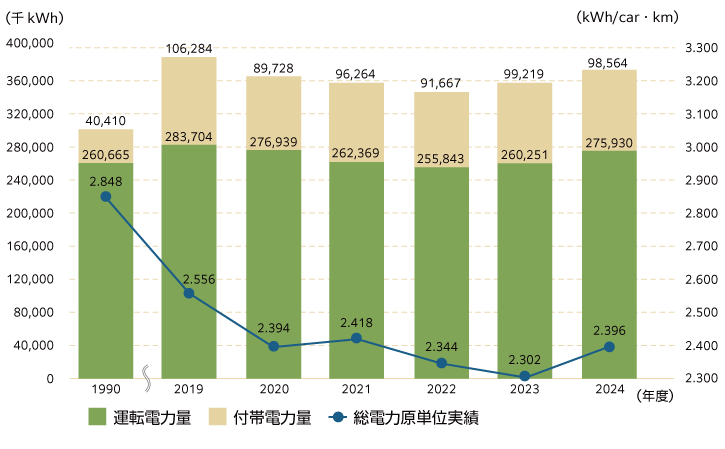
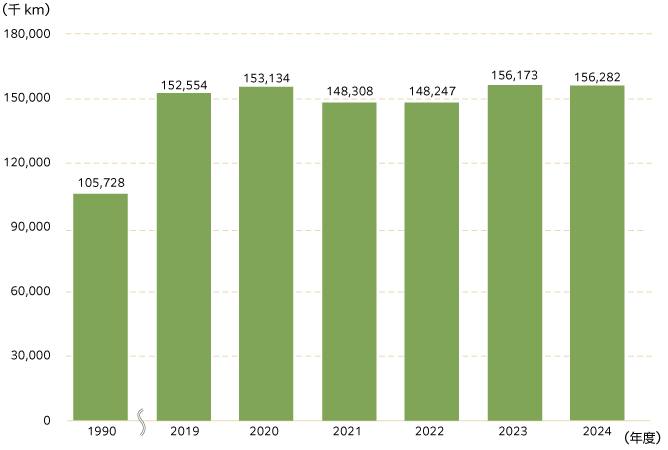
Tokyu Railways's power consumption can be divided into operating power, which is used to operate rolling stock, and incidental power, which is used to operate station facilities, signals, and security equipment.
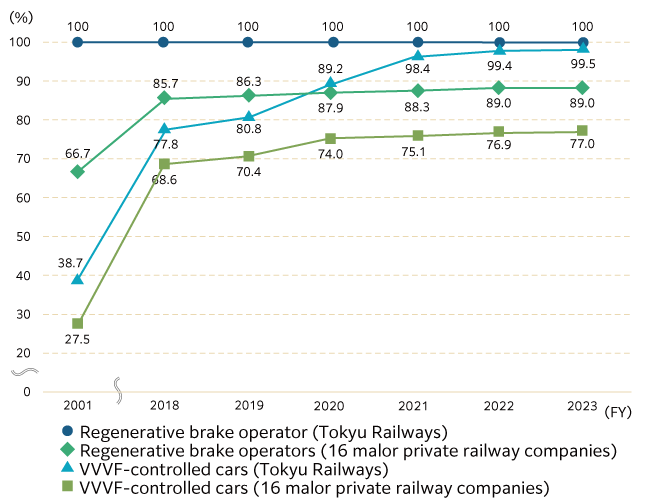
VVVF-controlled trains use inverters to convert the DC current flowing through the overhead wires into an AC current of optimum voltage and frequency to drive the AC motor. This reduces the loss of power. AC motors also have the advantage of being smaller, lighter, and less prone to failure.
Our company was the first in the industry to introduce VVVF-controlled vehicles in 1986. As of April 1, 2023, 99.5% of all vehicles will be VVVF-controlled, and we will continue to introduce VVVF-controlled vehicles in the future in line with vehicle renewals, etc.
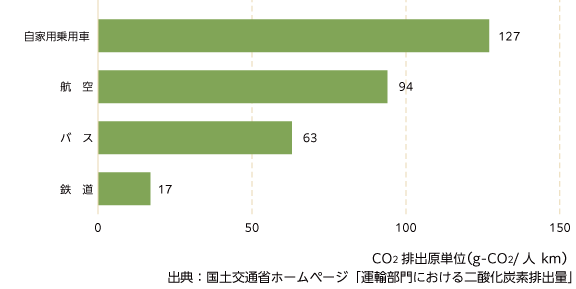
railway are a form of mass transportation and are said to be environmentally friendly. The amount of CO2 emitted per passenger kilometer traveled by railway is about one-fifth of that emitted by a private passenger car.
Tokyu Lines will transport approximately 10.1 billion passenger kilometers in fiscal 2024, carrying approximately 1.08 billion passengers per year, covering approximately 9.3 kilometers per person per trip (for reference, the 9.4 km distance between Shibuya Station and Futako-Tamagawa Station on the Den-en Den-en-toshi Line toshi Line). From April 1, 2022, all Tokyu Lines will be operated using 100% renewable energy with virtually zero CO₂ emissions. This is the first initiative in Japan to operate an entire railway line using 100% renewable energy. Note that a 9.3 km trip in a private car will emit 1,181 g of CO₂.
We conduct environmental accounting as a means of understanding the "cost of environmental conservation," the resulting "environmental conservation benefits," and the "economic benefits associated with environmental conservation," and evaluating the effects of environmental conservation through mutual comparison. Environmental accounting for FY2023 complies with the "Environmental Accounting Guidelines 2005 Edition" (Ministry of the Environment) and the "Private Railway Business Environmental Accounting Guidelines 2008 Edition" (The Association of Japanese Private railway).
Aggregation period: April 1, 2024 to March 31, 2025
(Unit: thousand yen)
| Classification | Details of the initiative | Investment amount | Cost amount | |
|---|---|---|---|---|
| (1) Business area costs The environmental conservation costs to control the environmental impact of our major business activities. |
Pollution prevention costs cost |
Measures to prevent air pollution, water pollution, noise, and vibration (maintenance of pollution prevention equipment, installation of soundproof walls, etc.) | 614,012 | 1,053,506 |
| Global environmental conservation costs | Energy conservation (introduction of new rolling stock, etc.), global warming prevention (installation of equipment to promote railway use, etc.)railway use, etc.) | 362,302 | 68,923 | |
| Resource circulation costs cost |
Proper disposal and recycling of wasteAppropriate waste disposal and recycling | 23,237 | 115,146 | |
| Total | 999,551 | 1,237,575 | ||
| (2) Upstream and downstream costs All costs to control the environmental impact caused upstream (suppliers) or downstream (customers) of our main business activities. |
Purchase costs for environmentally-friendly products, etc. | 0 | 300,222 | |
| (3) Management activity costs The environmental conservation costs related to management activities. |
Environmental management, information disclosure, environmental protection costs, etc. | 0 | 70,134 | |
| (4) Research and development costs The environmental conservation costs related to R&D activities. |
Development costs for products, etc., with reduced environmental impact, etc. | 0 | 4,607 | |
| (5) Social activity costs The environmental conservation costs related to social activities. |
Donations, sponsorships, etc. related to environmental protection | 0 | 8,012 | |
| (6) Environmental remediation costs The costs associated with responding to the environmental damage caused in the course of our business activities. |
Restoration of nature, compensation for damage related to environmental conservation, costs of dealing with environmental damage, etc. | 0 | 0 | |
| (7) Other costs Other costs related to environmental conservation. |
17,372 | 0 | ||
| Total environmental conservation costs | 1,016,923 | 1,620,550 | ||
| Railway track-related (rail scrap, etc.) | 1,525 | 69,760,000 yen |
|---|---|---|
| Electricity-related (coated wire scrap, etc.) | 219 | 40,084,000 yen |
| Vehicle-related (outer ring scrap, etc.) | 337 | 9,520,000 yen |
| Total | 2,081 | 119,364,000 yen |