
By promoting Human Capital management that maximizes the potential of each individual, we aim to strengthen the foundation of the entire group and achieve sustainable improvements in corporate value. the Company and its consolidated subsidiaries respect basic human rights and comply with the laws and regulations related to workers' human rights in each country in which we conduct business activities. We also support and respect the fundamental rights related to labor as stipulated in the ILO Declaration on Fundamental Principles and Rights at Work.
Since the early 2000s, we have been proactively working on work style reform and promoting the creation of an easy-to-work environment. However, in light of the rapid changes in the social environment and people's values, we are working on further reforms to realize more flexible work styles that will lead to improved productivity and innovation.
One representative initiative is the "Smart Choice" initiative, which allows employees to proactively choose the time and place of work that suits their job and environment, and we are establishing flextime and telework systems.
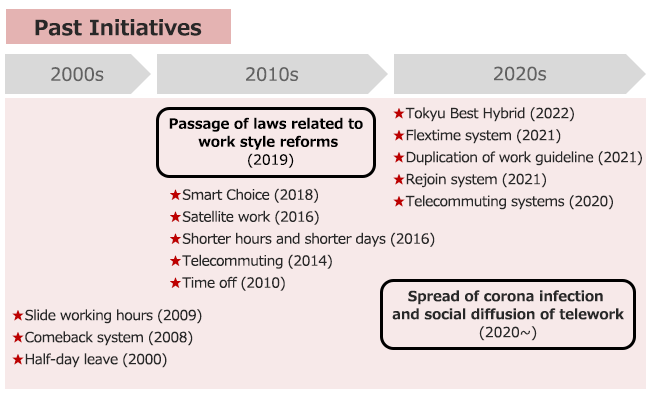
This is an initiative that allows employees to choose their own work style that suits their job and environment throughout the year. The aim is for employees to make independent choices that are not limited to traditional work styles, but that allow them to demonstrate their creativity and improve work efficiency.
By aligning the concepts of each measure before implementing them, we encourage employees to be self-disciplined, which leads to the development of a corporate culture and a change in employee mindset (attitude and behavior).
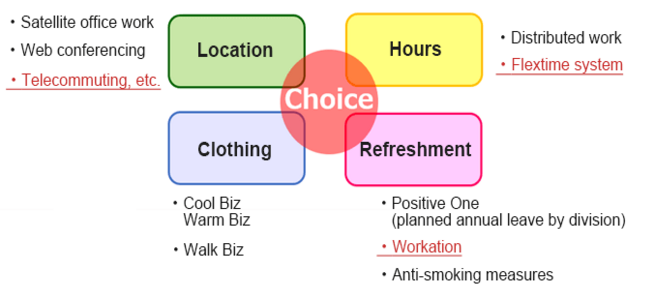
Our future work style will be based on a "Best Hybrid" policy, which involves effectively selecting and combining diverse work styles while being mindful of the mission and results of our employees and teams.
Based on this policy, we will strive to make effective use of flextime and telework systems, and to encourage each employee and team to demonstrate their "best performance."

Starting in September 2016, we have been implementing satellite office work for head office staff who have company-provided mobile devices (PCs, iPads, etc.). In addition to being able to use our member-only satellite shared office "NewWork" and its affiliated stores, we have also set up satellite offices exclusively for our employees in the areas served by Tokyu’s railway lines.
In addition, starting in October 2020, a telework system was introduced, allowing employees to flexibly choose where to work, without restrictions on the number of days or hours, as long as their supervisors recognize that the location provides an appropriate working environment and security, and that they can expect to achieve the same level of work efficiency and results as usual.
(example)
*This assumes that the above conditions are met.
* Procedures and rules for teleworking have been established and are posted on the company intranet.
In order to promote this type of location-independent work style, we have been working to improve the availability of mobile devices, such as lending mobile PCs and iPhones for business use to all head office staff.
We have implemented a system that allows employees to independently decide their daily "start and end times" and "working hours" ("work days/holidays" and "monthly scheduled working hours" remain the same as before).
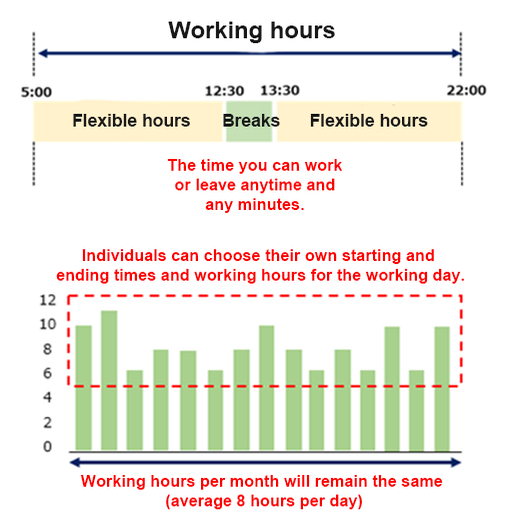
*Half-day and hourly leave can also be taken for saved annual leave.
Head office staff can participate throughout the year. We encourage employees to take the initiative in dressing appropriately according to their job and environment, to ensure that they do not cause offense to others, and to the extent that it does not interfere with work.
We take a number of steps to ensure that our employees have access to paid leave.
<Major Initiatives>
To prevent excessive workloads for our employees, we comply with local laws and manage working hours.
<Major Initiatives>
We have created a "Y-job responsibility" for those who are raising children, caring for the elderly, or providing nursing care, as well as middle-aged and elderly people working at railway sites (Tokyu Railways), which allows them to reduce their working hours or number of days by up to two hours per day or three days off per week.
| Reason | Target/Period |
|---|---|
| Childcare | Childcare recipients: Children living in the same household |
| Period of application of the system: Until the month of the child's 23rd birthday. | |
| nursing care | Eligible recipients of care: Relatives within the second degree of kinship. |
| Period of application of the system: Until it ends | |
| nursing | Nursing care recipients: Relatives within the second degree of kinship |
| Period of application of the system: Until it ends | |
| Injury, illness, or other reasons | Period of application of the system: Until it ends *Employee's own illness or injury, etc. |
| ① | Short-term work: 4 working days (1 day off from work) |
|---|---|
| ② | Part-time work: 6 hours of work (2 hours exempted from work) |
| ③ | Short-term/short-hour work: Both ① and ② |
| Reason | Work patterns | Short-time working system | YResponsibility |
|---|---|---|---|
| Childcare | Short number of days | not available | Available (until the month of your 23rd birthday) |
| Short time | Available (until April 30th of the 4th grade of elementary school) | ||
| nursing care | Short number of days | not available | Available (Care + nursing services currently in use) |
| Short time | Available (for 3 years) | ||
others |
Short number of days | not available | Available (while an illness or injury is occurring) |
| Short time | not available |
In order to develop the individuality of our employees and encourage them to utilize their experience and knowledge gained at other companies, we established guidelines for side jobs outside the company in April 2021. While focusing on our work, employees are also able to engage in a variety of independent activities outside of work.
This system allows employees who left the company due to pregnancy, childbirth, childcare, nursing care, a spouse's overseas posting, or to study for the purpose of self-improvement to return to work when they are able to do so. The comeback system was launched in 2008, and in April 2010, the period in which employees who use the system for the reason of "childcare" could return to work was extended from "until April 30 of the year in which the youngest child enters elementary school" to "until April 30 of the year in which the youngest child advances to the fourth grade of elementary school." In addition, the system became available for employees whose spouses are posted overseas from January 2016, and for employees who are studying for the purpose of self-improvement from January 2017.
As we hope that employees who have left the company for personal reasons will be able to utilize their experience gained at other companies, we have set up a dedicated recruitment desk from April 2021 (selection process including interviews will be conducted).
We act as organizer of the Human Resources and Labor Information Exchange Meeting, which is held twice a year with approximately 50 Tokyu Group companies to share current issues related to work styles and introduce examples of initiatives being taken by each company.
Our company complies with all national laws and regulations concerning human rights and labor, and strives to prevent child labor and forced labor. To prevent child labor, we thoroughly verify the age of all employees upon hiring. Furthermore, we prohibit young workers under the age of 18 from working overtime, night shifts, or engaging in dangerous tasks, and we take their health into consideration.
Furthermore, to prevent forced labor, we always hire based on the applicant's willingness to apply, and especially for mid-career hires, we provide written documentation outlining working hours, wages, etc., and only hire with the applicant's agreement.
In addition to complying with the legally mandated minimum wage, our company strives to pay a living wage that allows employees to maintain a certain standard of living by continuously reviewing and implementing wage levels and improving working conditions through labor-management consultations, taking into account price trends and changes in the labor market.
Furthermore, we pay all of our employees wages that exceed the legally mandated minimum wage.
In order to enhance the welfare of our employees and their families, in addition to the welfare system (statutory welfare systems) such as health insurance required by law, we also have our own welfare system (non-statutory welfare systems).
Dormitories, company housing, mutual aid associations, employee deposits, employee savings accounts, employee stock ownership plans, Seiwa Club (activities for promoting employee health and mutual friendship), death benefits, orphan education pensions, etc.
We have also established a welfare system called the "Guru-Comi * Plan" to provide subsidies for workplace social gatherings.
*Abbreviation for Group・Gourmet×Communication
Tokyu Mutual Aid Association is a mutual aid association jointly operated by the company and its employees, which provides various welfare services for the purpose of mutual assistance for members. 84 Tokyu Group offices (total of approximately 23,500 members as of the end of April 2025) are members. The mutual aid association operates the following systems.
A cafeteria plan is a system where employees can choose and use employee benefit plans within the scope of points that have been allocated to them in advance. Each plan, such as asset formation, self-development, and refreshment, has a set number of points required according to its content.
To facilitate communication between employees and their families and among themselves, and to promote good health, we have been holding relay races in collaboration with the labor union since autumn 2011, and athletic meets since spring 2012.
The relay race will feature mixed-gender teams and a half-mile section, with over 100 teams participating from each workplace.
The sports day includes events such as a children's relay race, a workplace tug-of-war, and a bread-eating contest, as well as other events that the whole family can enjoy.
Additionally, we have been holding family events for employees and their families since 2016. These events provide an opportunity for employees' families to deepen their understanding of the company by seeing our various initiatives and employees at work.
As a group-wide initiative, Tokyu Group Ekiden Championship was held in March 2025 with the aim of stimulating communication and promoting health. Families can also participate, and there is also a 50m sprint record competition for children, making it a tournament that families can enjoy.
Tokyu Corporation and Tokyu Railways are working with the Tokyu Labor Union on various initiatives to maintain and improve working conditions for employees, create a comfortable working environment, and promote the development of the company.
In consultations between labor and management, topics related to working conditions and working styles are discussed on an equal footing in accordance with the principle of good faith. Healthy labor-management relations are maintained by having labor and management respect each other's positions and deepening mutual understanding through dialogue.
* Union membership rate: 62.7% (as of the end of fiscal year 2025, combined figure for Tokyu Corporation and Tokyu Railways)
* Number of working days lost due to strike: 0 days (FY2024 and FY2025 actuals)
* Business interruptions due to labor disputes or strikes: None (FY2024 & FY2025 actuals)