Recognition of issues and response policy
To achieve our waste reduction targets, we have created and published the "Environmental Policy" and "Environmental Vision 2040," to deepen our understanding of the issues at hand. Based on this awareness, the Company and its consolidated subsidiaries will manage waste responsibly in accordance with laws and regulations regarding waste disposal procedures, reduce waste emissions through appropriate resource use, and work to realize recycling-based society. In addition to explaining our targets and specific actions, we also share good examples of waste reduction efforts, such as converting waste into valuable resources and promoting reuse, to encourage thorough company-wide efforts.
Goals and Results
the Company and its consolidated subsidiaries have set the following waste reduction targets.
FY2030: 20% reduction in revenue sources
FY2035: 25% reduction in revenue sources
FY2040: 30% reduction in revenue sources
*All comparisons are from fiscal 2019
Waste generation and recycling rate
| item |
unit |
FY2019
(Base year) |
2022年度 |
2023年度 |
2024年度 |
2025年度 |
Year-on-year change |
| Total waste volume |
t |
43,145 |
40,739 |
35,542 |
37,921 |
37,807 |
99.7% |
| |
Recycling volume |
t |
16,400 |
20,092 |
15,864 |
15,083 |
15,379 |
102.0% |
| Non recycling volume |
t |
26,745 |
20,647 |
19,678 |
22,838 |
22,428 |
98.0% |
| Recycling rate |
% |
38.0% |
49.3% |
44.6% |
39.8% |
40.7 |
102.3% |
| Operating revenue |
Billion Yen |
9,965 |
9,313 |
10,378 |
10,549 |
10,861 |
103.0% |
| a revenue unit basis |
t/billion yen |
4.33 |
4.37 |
3.42 |
3.59 |
3.48 |
97.0% |
| Reduction rate against base year |
% |
ー |
0.9% increase |
21.0% decrease |
17.1% decrease |
19.6% decrease |
ー |
* Operating revenue for fiscal 2019 and FY2020 is calculated based on the estimated impact of applying accounting standards for revenue recognition.
Examples of initiatives
Initiatives to reuse and recycle rolling stock (Tokyu Railways)
Tokyu Railways is working to promote resource recycling and reduce environmental impact by reusing retired rolling stock as much as possible.
We are working to transfer retired rolling stock that can still be safely used to other railway operators. Since 2000, we have transferred over 300 rolling stock, not only domestically but also overseas to the Indonesian National Railway. Reusing rolling stock as is has a smaller environmental impact than manufacturing new rolling stock, and is an initiative that contributes to the realization of recycling-based society. For rolling stock that is difficult to transfer, we dismantle them and separate them into materials such as steel, aluminum, and glass, and recycle them as much as possible. This has reduced waste per rolling stock by approximately 90%.
Furthermore, we are not limited to reusing used train parts; we are also working on upcycling, restoring them to a higher value. Tokyu Corporation and Tokyu Railways have produced and sold a limited run of 150 units of "WA," a lighting fixture made from straps from the 8500 series trains that operated on Den-en-toshi Line. The design, which makes use of used parts, combines the preservation of railway heritage with resource recycling. This initiative has been highly praised internationally, and was selected for the longlist (TOP 15) in the "lighting design" category of the Dezeen Awards 2025 design awards. The design was selected from 4,300 entries from 89 countries around the world, and was recognized for its ability to both solve social issues and be a good design.
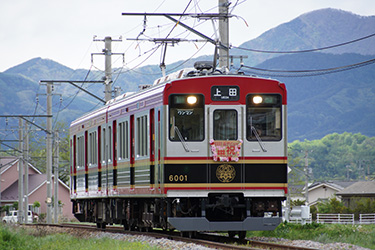 Ueda 1000 series
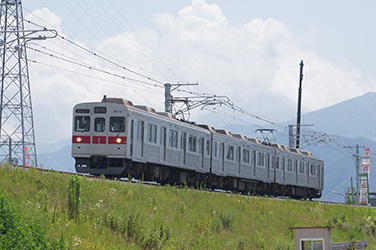 Nagano 8500 series
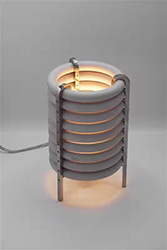 "WA" is a lighting fixture that utilizes hanging straps
Recycling of old materials (Tokyu Railways)
As part of the SOCIAL WOOD PROJECT, we are working to reuse and sell old wood from old wooden station buildings such as Ikegami Station on the Ikegami Line, in order to recycle old wood generated during renovation work at Tokyu Line stations.
In addition to holding workshops using old wood, the company utilizes the know-how of the Kozai Biyori Group, which collects, processes, and sells old wood.Old wood secured from construction work such as station improvements is processed at the Kozai Biyori Group's factory into products that retain the paint and texture of the station buildings, and is sold under the product name "Station Wood" through the Kozai Biyori Group sales site and other outlets.
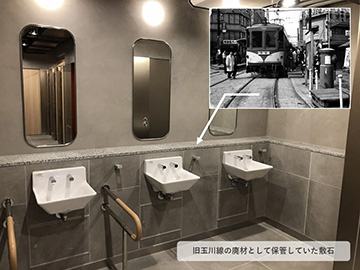
Additionally, during the renovation of Komazawa-Daigaku Station, paving stones that had been stored as waste materials from the old Tamagawa Line were used to make washbasins, thereby reducing CO₂ emissions during waste disposal.
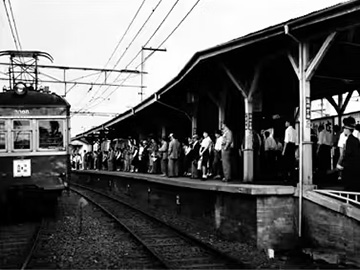 The old wooden Ikegami Station building (1959)
 Tabletop made from "Station Wood"