Recognition of issues and response policy
The Company and its consolidated subsidiaries recognize that water resources is one of the precious resources essential for the existence of living things, that water shortages are becoming more serious around the world, and that even within Japan, there are risks to securing a stable and safe water supply in some regions. We therefore work to conserve water resources by reducing the total amount of water used in accordance with the specific circumstances of each business area, using reclaimed water appropriate to its usage, and conducting appropriate wastewater treatment.
Targets and progress
As part of our long-term environmental goals set out in our "recycling-based society Vision 2040," we aim to "take advantage of the characteristics of our business, which has many customer contact points, to join and expand the circle of resource recycling and the circular economy toward a zero-waste society," and have set targets of reducing water usage a revenue unit basis by 20% by 2030, 25% by 2035, and 30% by 2040 (all compared to fiscal 2019). Water usage and a revenue unit basis for the past three years are as follows:
| |
unit |
FY2030
the goal |
FY2035
the goal |
FY2040
the goal |
FY2019
(Base year) |
FY2022
Achievements |
FY2023
Achievements |
FY2024
Achievements |
FY2025
Achievements |
Year-on-year change |
| Water Use |
1,000m³ |
ー |
ー |
ー |
8,497 |
7,061 |
7,112 |
7,340 |
7,623 |
103.9% |
| Operating revenue |
Billion Yen |
ー |
ー |
ー |
9,965 |
9,313 |
10,378 |
10,549 |
10,861 |
103.0% |
| a revenue unit basis |
1,000m³/100 million yen |
ー |
ー |
ー |
0.85 |
0.76 |
0.69 |
0.70 |
0.70 |
0 |
| Reduction rate against base year |
% |
20% reduction |
25% reduction |
30% reduction |
ー |
10.6% reduction |
18.8% reduction |
17.6% reduction |
17.6% reduction |
0 |
Environmental information data for the Company and its consolidated subsidiaries is disclosed on the following page.
Environmental Information Data for the Company and its consolidated subsidiaries
Water Management Plan
As part of our efforts to achieve our reduction targets under "Environmental Vision 2040," we have established water recycling (rainwater utilization, recycled water utilization through new technologies, and experimental efforts toward water recycling), and each business division and consolidated company is implementing a water reduction plan. Initiatives under "Environmental Vision 2040," in addition to company-wide water-saving initiatives, we are promoting the introduction of water-saving fixtures in toilets and showers in new properties, and are using rainwater and recycled water where possible.
Main Initiatives
To achieve our water usage reduction targets, we have created and published the "Environmental Policy" and "Environmental Vision 2040." We are rolling out water-saving measures based on the "Environmental Vision Guidelines" at each of our company's and consolidated company's bases, and are practicing water-saving activities suited to the characteristics of each facility. The "Environmental Vision Guidelines" not only explain our targets and specific actions, but also share good examples that contribute to reducing water usage, such as promoting recycled water, and encourage thorough water-saving activities across the company.
Company-wide initiative
Call for water conservation - Tokyu Corporation
To achieve our water usage reduction targets, Tokyu Corporation is making a company-wide appeal for everyday water-saving actions, such as when using the toilet. In our condominium brand "DRESSER," we have made five initiatives to reduce environmental impact standard features, and all properties and all units have obtained "ZEH Oriented" certification. In terms of Water Resources, we have made the introduction of water-saving toilets and showers a basic requirement.
Initiatives in each business division and consolidated company
Installation of water-saving tops and adjustment of water volume screws - Tokyu Store -
Tokyu Store Chain is working to reduce tap water usage by installing water-saving devices in its kitchens. This initiative not only saves water, but also contributes to reducing CO₂ emissions. By installing water-saving devices in the kitchens of each business location, the chain is working to conserve Water Resources and reduce CO₂ emissions. These devices use "pulsating flow" technology, which mixes water and air before discharging it, significantly reducing the amount of water used while maintaining high cleaning power. The water pressure and volume can be adjusted according to the tasks being performed in each kitchen, and the chain is continually working to reduce its environmental impact.
Adjustment of water-saving piece and water volume screw
Use of well water
To achieve our water usage reduction targets, our company and the Group are working to reduce water usage by using well water.
As of 2025, it has been introduced in the following facilities.
Facility names: Nagoya Tokyu Hotel, Kyoto Tokyu Hotel, Izu Imaihama Tokyu Hotel, Tama Plaza Terrace, Tokyu Chuo Rinkan Building
Rainwater Utilization
To achieve our water usage reduction targets, our company and the Group are working to reduce water usage on roads and other roads by using rainwater.
As of 2025, it has been introduced in the following facilities.
Facility names: Tokyu Capitol Tower, Cerulean Tower, Shibuya Stream, Futako Tamagawa Rise, Bunkamura, Shibuya Scramble Square
Use of recycled water (wastewater and reclaimed water)
Shibuya Scramble Square, a large-scale complex that opened in November 2019, is taking steps to conserve Water Resources, leading to a reduction in water usage with the aim of making effective use of Water Resources and reducing the burden on sewerage facilities.
Please see below for details.
Effective use of Water Resources through the installation of recycled water facilities -Shibuya Scramble Square-
Additionally, the following facilities are also using recycled water to reduce water usage.
Facility names: JR Tokyu Meguro Building, Tokyu Capitol Tower, Cerulean Tower, Shibuya Stream, Tokyu Kabukicho Tower, Tokyu Hakata Building, Shibuya Hikarie, Futako Tamagawa Rise, Bunkamura, Shibuya Scramble Square, Miyakojima Tokyu Hotel & Resorts
External collaboration initiatives
Aiming to realize recycling-based society through reduced Water Resources consumption, our three companies, Chodai Corporation, and Token Sangyo Co., Ltd., have introduced a water circulation system utilizing complex fermentation technology to SOIL (Shibuya Open Innovation Lab), an open innovation lab operated by Tokyu in Shibuya, starting in 2025. After a two-year joint demonstration in Miyakojima, Okinawa, the system's stable operation and high wastewater treatment capacity were confirmed, leading to its full implementation. SOIL uses complex fermentation equipment to purify wastewater discharged from toilets and kitchens and reuse it for toilet flushing. This reduces the amount of new tap water used and improves the facility's overall Water Resources utilization efficiency. The system utilizes biological treatment (complex fermentation technology) without the use of residual chemicals, using microorganisms to purify the water for reuse, resulting in environmentally friendly wastewater treatment. Through this initiative, we will establish an operating scheme for a system that utilizes complex fermentation technology, and by expanding its introduction to facilities in various areas, including those along areas served by Tokyu’s railway lines, we will contribute to the realization of recycling-based society.
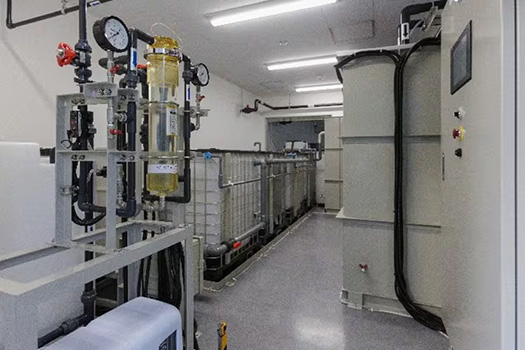
<Complex fermentation equipment installed at SOIL>
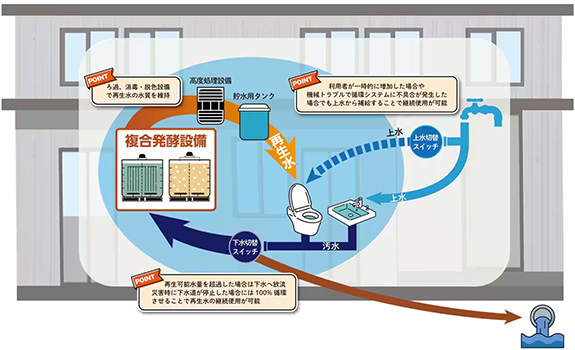
<Water circulation system diagram>
Tokyu Foundation Initiatives
In 1974, Tokyu established the Tokyu Foundation for Environmental Cleanup (now the Tokyu Foundation, a public interest incorporated foundation) to conduct research grants for the Tama River basin, which flows through the heart of its business area, as it believed it was an important corporate responsibility to promote environmental cleanup in the Tama River basin. (Until FY2022, the foundation has provided grants totaling 1.54 billion yen to 1,332 academic and general research projects.) From fiscal year 2024, the foundation has been redesigned to provide grants in the hope of deepening collaboration between the activities of private nonprofit organizations (NPOs/NGOs, voluntary organizations, etc.) and the research of researchers and research institutions (organizations).
We have also produced an environmental education supplementary reader, "Welcome to the Tama River," which we distribute free of charge every year to elementary schools in the Tama River basin. This supplementary reader was produced with the aim of helping children gain knowledge and a sense of familiarity with the Tama River, which nurtures a variety of living creatures and brings blessings to the people living in the basin, and was created with the expectation that it would be used in elementary school classes and extracurricular activities. In fiscal 2024, we distributed 8,183 copies to 95 elementary schools in the Tama River basin.
Tokyu Foundation Environmental Activities
Understanding water risks at business locations
General water risks
In order to identify areas with high water stress levels at our business sites, including our consolidated subsidiaries, we used the WRI Aqueduct tool developed by the World Resources Institute (WRI) to quantify the water stress levels at all of our business sites, both in Japan and overseas, and to identify areas with high water stress.
Regarding overall water risks, most business locations do not fall under the medium-high or higher water risk level, and there are no major concerns about water risks for the time being. However, we are continuing to monitor water usage while working to make it more efficient.
Water Risk
(OVERALL RISK *1) |
Number of bases
(Water used) |
ratio |
2024年度 |
| Water Intake |
Displacement |
| 0-1 Low |
54 |
6.1% |
572 thousand m3 |
570 thousand m3 |
| 1-2 Low-Medium |
821 |
93.4% |
6,564 thousand m3 |
6,606,000m3 |
| 2-3 Medium-High |
1 |
0.1% |
46,000m3 |
46,000m3 |
| 3-4 High |
3 |
0.3% |
158 thousand m3 |
158 thousand m3 |
| 4-5 Extremely high |
0 |
0.0% |
0 |
0 |
| Total |
879 |
100% |
7,340 thousand m3 |
7,380 thousand m3 |
*1 OVERALL RISK: Overall risk including water stress, depletion, seasonal fluctuations, river flooding, drought, untreated wastewater, and sanitation facilities
Locations at high risk of water stress and water withdrawal volume
The sites with high water stress risk (>40%) identified using the WRI Aqueduct tool developed by the World Resources Institute (WRI) and their water usage are as follows, and there were no sites with significantly high risk (>80%). If the water withdrawal volume in FY2023 is set at 100%, the water withdrawal volume at sites with high water stress risk accounts for 0.5% of the total.
| |
|
2024年度 |
High Risk
(40-80%) |
Number of bases |
2 |
| Water consumption (1,000 m3) |
48 |
Significantly high risk
(>80%) |
Number of bases |
0 |
| Water consumption (1,000 m3) |
0 |
At our two overseas locations (Yanchep, Australia and Sriracha, Thailand) where the risk of water stress is high, we are working to increase the efficiency of water use and will continue to hold discussions and dialogue with external stakeholders to ensure appropriate water use.
