
The Company and its consolidated subsidiaries have been working to solve social issues through our business, focusing on Urban and community development based on railway. As we develop a wide range of businesses, we have built a diverse supply chain. As a responsible member of the global supply chain, we recognize that we are required to address human rights and environmental issues not only within our company but also in our supply chain. We have formulated a "Sustainable Supply Chain Policy" to share our thoughts on human rights and environmental issues with our business partners, recognize the environmental and social risks in the supply chain in all transactions, including raw material and product procurement, strive to understand the issues in the supply chain we are involved in through business activities, and engage in optimal business activities to realize a sustainable society.
The Company and its consolidated subsidiaries have adopted "Toward a beautiful age" as the Group slogan and share a Group mission statement: We shall strive to create beautiful living environments, in which each person can pursue individual happiness in a harmonious society.
Under this slogan and mission statement, the Company and its consolidated subsidiaries ensure that related laws, regulations and other requirements are observed, and that fair, equitable and transparent procedures are followed based on the principle of free competition in all business dealings including procurement activities in Japan and abroad. We also recognize the need to ensure quality, set optimum prices and adhere to delivery deadlines, as well as to consider issues such as human rights and the environment, while engaging in responsible activities that help create social value and economic value throughout the supply chain.
To work with the business partners in fulfilling responsibilities to create a sustainable society as demanded by society, in this policy the Company and its consolidated subsidiaries respect international norms including the ten principles in the four areas (human rights, labour, environment and anti-corruption) of the United Nations Global Compact of which the Company is a signatory, and have set forth the matters to be observed. The Company and its consolidated subsidiaries request that the business partners associated with its businesses, products and services understand the purpose and contents of this policy and cooperate with putting it into practice.
The policy applies to the entire supply chain including direct and indirect business partners associated with all products, services and raw materials procured by or supplied to the Company and its consolidated subsidiaries.
In accordance with the human rights policy, basic safety policy, anti-corruption policy and environmental policy established by the Company, we seek cooperation in understanding and implementing the following matters from the supply chain in all aspects of business transactions including the procurement of raw materials and products. Please refer to the following PDF file for specific items to be observed.
Sustainable Supply Chain Policy
| 1. Ensuring safety and improving services and quality | (1) Safety assurance |
|---|---|
| (2) Quality control and the creation of quality assurance systems | |
| (3) Disclosing necessary information concerning products and services | |
| 2. Compliance with various laws, regulations and other requirements | |
| 3. Respect for human rights and consideration for work environments | (1)Respect for human rights |
| ①Compliance with and respect for international standards on human rights and labor | |
| ②Prohibition of discrimination | |
| ③Prohibition of harassment | |
| ④Respect for local residents and communities | |
| ⑤Respect for the rights of socially vulnerable persons and minorities | |
| (2) Ensuring healthy, safe and comfortable work environments | |
| ①Freedom of association and collective bargaining rights | |
| ②Prohibition of forced or compulsory labor | |
| ③Prohibition of child labor | |
| ④Payment of wages equal to or above the minimum wage | |
| ⑤Prohibition of long working hours | |
| ⑥Workplace health and safety measures | |
| ⑦Preparation for emergency | |
| ⑧Prevention of occupational accidents, injury and illness | |
| ⑨Industrial hygiene measures | |
| ⑩Measures to address physically demanding work | |
| ⑪Ensuring sanitary facilities and appropriate environments for eating and living | |
| ⑫Protecting the rights of foreign nationals and migrant workers | |
| 4. Thoroughly ensuring fair trade | (1) Prevention of corrupt practices |
| (2) Exclusion of anti-social forces | |
| (3) Protection of intellectual property | |
| (4) Establishment of whistleblowing and consultation systems and prohibition of retaliatory behavior | |
| 5. Environmental considerations | (1) Responding to climate change |
| (2) Preservation of biodiversityBiodiversity | |
| (3) Prevention of pollution | |
| (4) Effective use of resources | |
| (5) Appropriate use of water | |
| (6) Appropriate utilization of forest resources | |
| 6. Appropriate information management | |
| 7. Development of BCP | |
| 8. Contributing to local communities |
Sustainability Promotion Committee, a subordinate body of the Management Meeting, plans, proposes and makes recommendations regarding basic management policies related to supply chain management, as well as business activities and corporate policies and strategies.
The activities of Sustainability Promotion Committee are appropriately supervised by the Board of Directors, and matters for discussion are regularly submitted to and reported on the Management Meeting and the Board of Directors.
| Chairperson, Sustainability Promotion Committee | Masahiro Horie (President & Representative Director, Chief Executive Officer) |
|---|---|
| Chief Sustainable Supply Chain Officer | Kazuyoshi Kashiwazaki (Managing Executive Officer) |
| Division Responsible for Promotion | ESG Promotion Group , Corporate Planning Division |
Please refer to the following link for details regarding the sustainability management promotion system and the activities of the Sustainability Promotion Committee.
We will promote business with business partners who will comply with the above policy and will work with us to fulfill the responsibilities that society expects of companies. In addition, for business partners with whom we have ongoing transactions, we will regularly check their compliance with the above policy and encourage them to make improvements as necessary.
In April 2023, we revised our previous Sustainable Procurement Policy (established in 2006) to Sustainable Supply Chain Policy in order to optimize business activities our efforts to achieve a sustainable society and to solve social and environmental issues. This revision expanded the scope of application to include the entire supply chain, including business partners, which is directly or indirectly related to all goods, services, and raw materials procured and provided in the the Company and its consolidated subsidiaries business. In 2023, when this revision was made, all existing business partners * of the Company and its consolidated subsidiaries were informed in writing of Sustainable Supply Chain Policy and Sustainable Supply Chain Policy Explanatory Notes. In addition, we held briefing sessions for suppliers in various regions to disseminate this policy and put it into practice. This policy has also been translated into English.
The "Sustainable Supply Chain Policy" is structured to reflect our "Human Rights Policy", "Environmental Policy", "Basic Safety Policy" and "Anti-Corruption Policy", and the "Sustainable Supply Chain Policy Explanatory Note" includes "Human Rights Policy", "Environmental Policy", "Basic Safety Policy" and "Anti-Corruption Policy" as annexes to disseminate the policy.
*Tokyu Corporation alone: 1,920 existing business partners (FY2023), approximately 30,000 companies per contract (FY2024)
In order to promote awareness Sustainable Supply Chain Policy deepen understanding of its purpose and content, and ensure its implementation throughout the supply chain, we have created the "Sustainable Supply Chain Policy Sustainable Supply Chain Policy, related laws and regulations, and provides specific implementation guidelines, with the "Human Rights Policy," "Environmental Policy," "Basic Safety Policy," and "Anti-Corruption Policy" included as appendices. We distribute this commentary to our business partners so that they can raise awareness, promote awareness, and put the policy into practice among their employees.
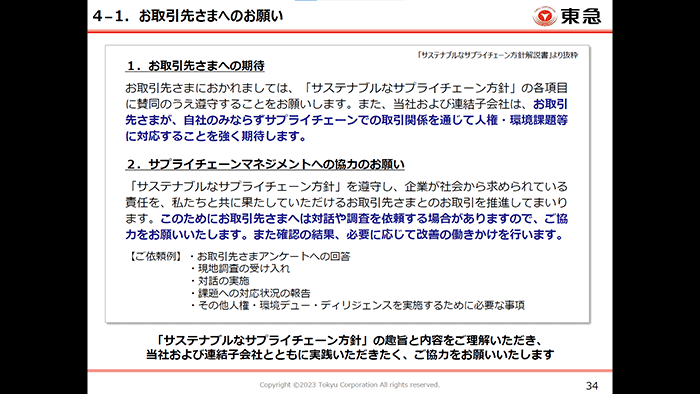
In order to gain understanding and approval of the Company and its consolidated subsidiaries' approach to social responsibility and the matters we would like our business partners to comply with, we notified existing business partners in writing when we revised Sustainable Supply Chain Policy in 2023. We also held briefing sessions for business partners in various regions to explain the Company and its consolidated subsidiaries' sustainability initiatives and Sustainable Supply Chain Policy, which was revised in April 2023, with the aim of resolving social issues related to human rights and the environment in the supply chain, which have been gaining global attention in recent years. We requested our business partners to understand and practice the policy, including disseminating it to their own employees.
The briefing session was attended by supply chain management personnel from the Company and its consolidated subsidiaries, who deepened their understanding of this initiative. Briefing sessions have been held every year since then.
Number of companies participating in briefing sessions for business partners
2023 95 companies
2024 111 companies
2025 108 companies
Online Seminar
As part of our support for our business partners in their efforts to address human rights, we have created e-learning (training videos) and a handbook on "Business and Human Rights" for our business partners. Starting in January 2025, we will be asking business partners of the Company and its consolidated subsidiaries to take these courses.
This training video is structured to reflect our company's "Human Rights Policy," "Environmental Policy," "Basic Safety Policy," and "Anti-Corruption Policy," and by watching this training video, you can gain a concrete understanding of the content of each of our policies and the "business and human rights" that companies should address. Through this training video, we are working to spread awareness throughout the supply chain and put it into practice.
the Company and its consolidated subsidiaries select business partners based on their compliance with our "Sustainable Supply Chain Policy" to address human rights, environmental, and social issues. We provide them with a "Sustainable Supply Chain Policy and Implementation Request" document and request their understanding of the policy and their cooperation in implementing it. Our company's internal regulations also stipulate that each division must appoint a "Sustainable Supply Chain Manager" to select business partners who comply with the eight criteria set out in the Sustainable Supply Chain Policy, including compliance with various laws and regulations, Respect for Human Rights, consideration for the working environment, thorough fair trade practices, and consideration for the environment. We also provide guidance to the consolidated subsidiaries of the relevant divisions on establishing an operational system that will enable them to select business partners in the same manner.
To identify, prevent, mitigate, and appropriately respond to sustainability risks in the supply chain, the Company and its consolidated subsidiaries will conduct due diligence on our business partners every year starting from FY2023 Details of due diligence on business partners are as follows:
As part of our due diligence, the Company and its consolidated subsidiaries conduct annual questionnaire surveys of our major business partners to monitor the status of their efforts regarding our Sustainable Supply Chain Policy and conduct risk assessments. Through risk assessments conducted through questionnaire surveys and direct visits, we aim to achieve sustainable growth together with business partners.
Regarding the business partners of Tokyu Corporation and its consolidated subsidiaries, we have identified major business partners (significant business partners) with high transaction amounts in stages from the top of each fiscal year, based on their influence on the Company's business in each of the four segments (Transportation, real estate, life service, and hotel and resort) and "Others." We held a "briefing session on Sustainable Supply Chain Policy" for the business partners and sent a questionnaire in line with the "Sustainable Supply Chain Policy". business partners is requesting your understanding and cooperation in this policy along with your response.
95 companies FY2023
111 companies in 2024
108 companies in 2025
The survey conducted in fiscal 2025 covered the following 66 questions in line with the Sustainable Supply Chain Policy.
It has been created in line with Sustainable Supply Chain Policy addressing environmental issues such as Environmental Policy and GHG reduction targets, social issues including human rights and labor issues such as employee working conditions and fair wages, and the handling of personal information.
| Question classification | Number of questions | |
|---|---|---|
| 1. Ensuring safety and improving services and quality | 7 questions | |
| 2. Compliance with various laws, regulations and other requirements | 2 questions | |
| 3. Respect for human rights and consideration for work environments | 27 questions | |
| (1)Respect for human rights | 7 questions | |
| (2)Ensuring healthy, safe and comfortable work environments | 20 questions | |
| 4. Thoroughly ensuring fair trade | 5 questions | |
| 5. Environmental considerations | 15 questions | |
| 6. Appropriate information management | 3 questions | |
| 7. Development of BCP | 2 questions | |
| 8. Contributing to local communities | 1 question | |
| 9. Cooperation to Put the Compliance Items into Practice | 4 questions | |
| Total | 66 questions | |
As shown in the figure below, the survey results show that while there has been some progress in quality and human rights-related initiatives, the average scores for cooperation and environmental considerations are slightly lower. Regarding cooperation, it was found that suppliers still have a long way to go in their supply chains, and regarding environmental considerations, there are issues with quantitatively understanding suppliers.
Number of companies surveyed
2023 95 companies
2024 111 companies
2025 108 companies
Survey response rate
2023 86%
2024 89%
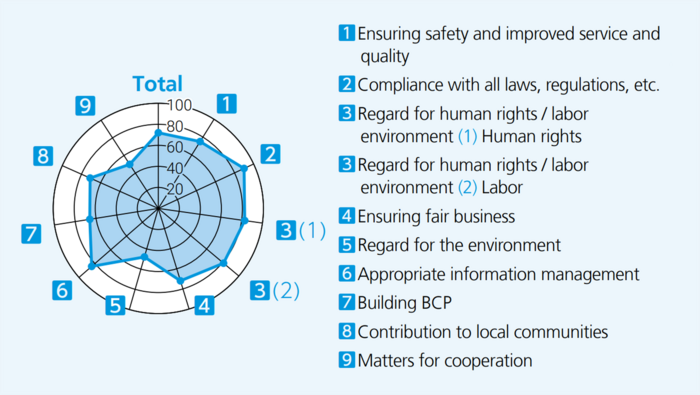
Response by domain as indicated by business partners survey results
We provide written feedback on the results of our surveys to all business partners who respond to the survey.
The written feedback will indicate the areas where you have not yet achieved each issue in your survey responses and ask you to correct these shortcomings.
The risk assessment of suppliers is based on the questionnaire survey business partners,
1) "Status of efforts (level of achievement) with regard to Sustainable Supply Chain Policy based on the questionnaire survey, including human rights, environmental and social issues": degree of risk management
(2) "Whether the company handles industries that are considered to have high sustainability (human rights, environmental, etc.) risks, employs foreign nationals (language and custom barriers), or handles specific products (products banned for import due to forced labor and child labor in the U.S.)": potential risks.
Risks are evaluated based on the two elements of (1) and (2), and "business partners* with potentially high risk" are identified for both items (1) and (2).
* 6 companies FY2023
14 companies in 2024
We hold direct dialogue with business partners who may be at high risk, asking about the status of their efforts in relation to the survey results. We also deepen mutual understanding of their thinking on human rights, governance, and other issues, as well as the details of their efforts and challenges. We provide feedback on the survey results and present improvement measures for any corrections required, and ask for their cooperation in operating their business in accordance with our Sustainable Supply Chain Policy, which includes human rights and environmental issues.
Furthermore, the dialogue visits have led to the initiation of harassment response operations (creating policies, setting up a hotline, informing employees, etc.), the introduction of an objective system for tracking working hours, and the ongoing search for alternative suppliers for specific products.
When ordering uniforms for Tokyu Railways employees, the company conducted on-site audits of two of its suppliers, a fabric factory and a sewing factory, as these products fall under the "clothing" category (target: Vietnam) on the list of specific commercial materials. Prior to the audit, the company conducted a preliminary check to confirm the status of quality control, including production management and inspection systems, as well as the state of response to human rights and supply chain-related issues, such as Respect for Human Rights, consideration for the working environment, and consideration for the environment. The on-site audit confirmed the absence of actual child labor, the status of labor management, workplace safety and hygiene measures, and the establishment of emergency evacuation routes. As a result of the audit, no serious violations of laws and regulations or non-compliances such as child labor were found.
FY2023, we conducted audits of sewing factories in Vietnam and Indonesia.
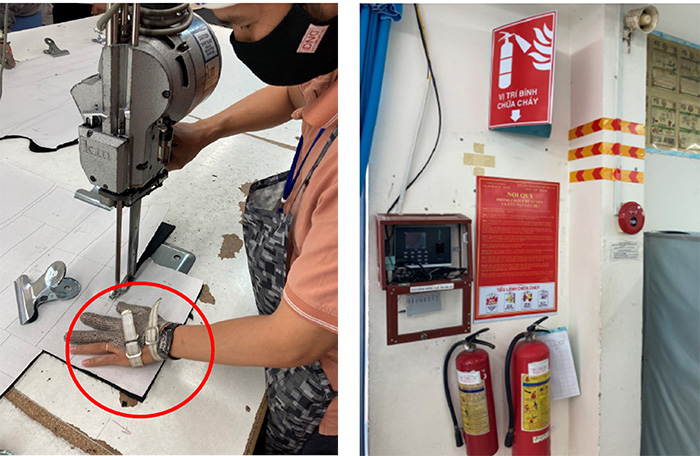
(Left) An employee of a business partner cuts fabric while wearing metal gloves to prevent injury.
(Right) Checking the availability of fire extinguishers and first aid supplies, and emergency evacuation routes
business partners of Sustainable Supply Chain Policy, hold explanatory meetings, and conduct surveys and provide feedback on the results. In addition, we will consider expanding our grievance mechanism to be in line with the Guiding Principles and create human rights awareness tools, aiming for sustainable growth together with business partners.
(1) Buyer Training
the Company and its consolidated subsidiaries At MSI, we recognize that all employees play the role of buyers, and we provide training for all employees. The "Compliance Training" is held every year, in which ESG-related policies and statements at the Company and its consolidated subsidiaries are explained, and the "Sustainable Supply Chain Policy", which is structured to reflect our "Human Rights Policy", "Environmental Policy", "Basic Safety Policy", and "Anti-corruption Policy", is also made known to all employees. In addition, in FY2025, the Group, in collaboration with the Human Resources Department, created a "Business and Human Rights" training video and handbook to provide training to employees.
In addition, the Group Sustainability Promotion Committee and Sustainability Promotion Committee have asked our employees and the employees of each of our consolidated subsidiaries to disseminate this policy to the employees of their respective companies, and each consolidated subsidiary is working to disseminate the policy to its employees via its intranet and other means.
(2) Purchasing policy
In accordance with our internal regulations, we have appointed a sustainable supply chain manager in each division, and we select business partners that meet the eight requirements set out in our Sustainable Supply Chain Policy, including compliance with various laws and regulations, Respect for Human Rights, consideration for the working environment, thorough fair trade practices, and consideration for the environment. Based on our internal regulations, the supply chain managers appointed in each division select business partners that meet our policy, and even after starting business with us, we inspect whether the business partner is complying with our policy and promote improvements.
In July 2022, we held a sustainability seminar entitled "Business and Human Rights: What We Should Initiative to Seek New Corporate Value" to raise awareness of "Business and Human Rights" for our full-time officers and representative Director of consolidated subsidiaries.
We invited a guest speaker from the Caux Round Table Japan, a non-profit organization, to speak about "business and human rights," a topic that the Company and its consolidated subsidiaries should address. He spoke about "what must not be changed" and "what must change," based on global trends including the United Nations' "Guiding Principles on Business and Human Rights," as well as Group Philosophy and our company's DNA.
To further promote initiatives in the supply chain regarding the environment, human rights, and Corruption Prevention, we hold the "Tokyu Group ESG Promotion Seminar" for employees of the Company and its consolidated subsidiaries. By sharing the significance of initiatives in the supply chain and leading examples, we strive to raise and improve employee awareness.
| Month | Content | subject |
|---|---|---|
| February 2023 (Online) |
Tokyu Group ESG Promotion Seminar "The supply chain management required today" Ms. Makiko Akabane, CSR Asia Japan Representative | All consolidated employees (if desired) |
We conduct compliance training every year to ensure that each employee acts with awareness and complies with laws, regulations, and rules, as well as social demands such as ethics and environmental issues. This training includes specific examples of our Code of Conduct. During this training, we explain the ESG-related policies and statements of the Company and its consolidated subsidiaries, and also inform all employees of our Sustainable Supply Chain Policy. The attendance rate in fiscal 2024 was 100%. Furthermore, the "Business and Human Rights" training created and implemented in fiscal 2025 also explained our supply chain policy from a human rights perspective.
Furthermore, we have requested our consolidated subsidiaries to inform their employees of this policy at the time of policy establishment and at the Group Sustainability Promotion Committee, and each consolidated subsidiary is working to inform its employees via its intranet and other means.
We have set up an internal reporting system, which is located within the company and at a law firm, and which responds to reports and inquiries from employees of the Company and its consolidated subsidiaries (including business partners).
In addition, Tokyu Customer Center handles customer comments and inquiries.
Internal whistle-blowing system to address compliance issues