
The Company is a member of the Group Mission Statement" to create beautiful living environments, in which each person can pursue individual happiness in a harmonious society." Tokyu Group Compliance Guidelines Corruption Prevention the United Nations Global Compact In March 2018, we identified six "Sustainability Materiality Themes" as social issues to be addressed, and under the themes of "Human Resource Development and "Corporate Governance and Compliance," we are working on "Realization of Human Rights" as one of the social issues to be addressed.
In 2011, the United Nations Guiding Principles on Business and Human Rights were adopted, and by 2020, an Action Plan on Business and Human Rights will be formulated in Japan, further increasing the importance of corporate efforts to address human rights. the Company and its consolidated subsidiaries In order to fulfill the "Corporate Social Responsibility" set forth in Group Philosophy, UNICEF has formulated Human Rights Policy as a commitment to fulfill its responsibility to respect human rights. With regard to children's rights, we support the UNICEF "Children's Rights and Business Principles" and will practice respect for children's rights, including the effective abolition of child labor. Please note that this policy has been discussed and approved by our the Management Meeting, approved by the Board of Directors, and signed by President & Representative Director.
the Company and its consolidated subsidiaries will continue to work on respecting human rights in accordance with Human Rights Policy to realize a sustainable society and enhance our corporate value.
*The Company and its consolidated subsidiaries have formulated a human rights policy based on the Guiding Principles on Business and Human Rights adopted by the United Nations Human Rights Council.
The Company and its consolidated subsidiaries have adopted the Tokyu Group slogan, "Toward a Beautiful Age - Tokyu Group," as the universal value standard and "We shall strive to create beautiful living environments in which each person can pursue individual happiness in a harmonious society" as the mission statement. We understand that the human rights of all people affected by our business activities must be respected in order to truly contribute to the realization of a sustainable society. As a guideline for fulfilling this responsibility, we hereby formulate the "Human Rights Policy" (hereinafter referred to as the "Policy") and promote our efforts to respect human rights.
* Includes support and respect for the core labour principles: abolition of child labor, elimination of forced or compulsory labor, elimination of discrimination (race, religion, gender, age, sexual orientation, disability, nationality, etc.), and freedom of association and the effective recognition of the right to collective bargaining.
June 29, 2023, Revised
November 1, 2022, Established
Tokyu Corporation
President & Representative Director

| Person in Charge | Hamana Setsu (Senior Managing Executive Officer) (Hamana Setu) |
|---|---|
| Division Responsible for Promotion | ESG Promotion Group , Corporate Planning Division |
The Company positions the Board of Directors as the highest management and supervisory body, and important matters related to sustainability, including human rights, are resolved and overseen by the Board of Directors.
In addition, Sustainability Promotion Committee chaired by President who is also a member of the Board of Directors is responsible for overseeing overall initiatives related to sustainability, including human rights. The committee implements comprehensive initiatives, including spreading awareness among consolidated companies and carrying out various educational activities.
Furthermore, based on Human Rights Policy, President & Representative Director and CEO appoints officers in charge of implementing this policy as shown in the table above and oversees its implementation. Furthermore, to ensure that our human rights initiatives function and are implemented reliably, we have established the following system for daily supervisory responsibilities and role allocation.
●Department promoting Respect for Human Rights initiatives
Overall: ESG Promotion Group Corporate Planning Division
● Responses regarding employees
Our company employee: Human Resources Division and general manager of each business division
Consolidated subsidiary employees: Human Resources Promotion Office, General Manager of each business division, Consolidated subsidiary
● Responses regarding business and business partners, etc.
Our business and business partners: responsible for overseeing each business division
Consolidated subsidiary business and business partners: General manager of each business division and consolidated subsidiaries
In addition to daily cooperation, important human rights issues are discussed and information is shared at Sustainability Promotion Committee, which is attended by the general managers of each business division, to promote company-wide initiatives.
the Company and its consolidated subsidiaries began conducting human rights risk assessments in FY2022 We identify potential adverse human rights impacts (human rights risks*) that may occur in our business and its supply chain in five business areas: transportation, real estate, life service business, hotel and resort, and hospitals, and analyze and assess their impact and importance.
In conducting the analysis and assessment, we engaged external experts to grasp the overall picture of human rights risks (potential and actual) in each business from the perspective of human rights in the supply chain of the businesses of the Company and its consolidated subsidiaries, risks identified by international organizations and NGOs, examples of actual risks within the industry, and interviews with our relevant departments (major affiliated companies). After conducting screening, we identified and assessed the following particularly significant risks from the perspectives of "severity" and "likelihood."
As part of this human rights risk review process, we annually hold dialogues with stakeholders and gather their opinions regarding identified significant human rights risks, and then periodically review the risks based on the results of these dialogues.
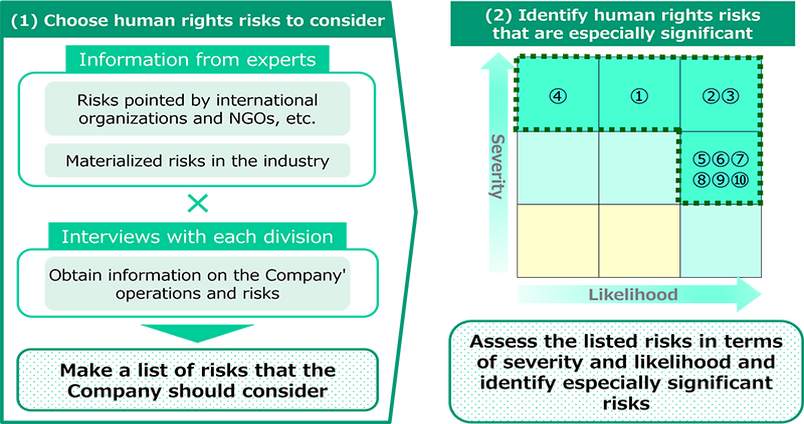
The 10 significant human rights risks that have been identified as important risks that should be considered by the Company and its consolidated subsidiaries are as shown in the table below.
The top priority risks are “Serious forced labor, slave labor and child labor involving employees of domestic and foreign suppliers” and “Health and safety violations of the company or its tenants’ products and services against consumers” in all businesses, “Lack of safety and health and serious forced labor, slave labor and child labor within subcontracting construction companies, etc.” in the Real Estate Business and “Indirect involvement in human trafficking, etc.” in the Hotel and Resort Business. The other risks identified as especially significant ones to be considered are “Discrimination against customers (consumers) when service is provided” in all businesses except the Hospital business, “Leakage of personal information resulted in the invasion of privacy” in the Real Estate, Life Service, and Hospital businesses, and “Workplace bullying between employees, occupational health and safety violations, long working hours, nonpayment of wages, etc.” related to the employees of the Company and its consolidated subsidiaries.
| Target of human rights violations | Human rights risks | Prime associated business domain | |||||||
|---|---|---|---|---|---|---|---|---|---|
| Transportation | Real estate | Life service |
Hotel Resort |
Hospital | • Preventive and corrective response policies...■ •Initiatives for 2024...✓ |
||||
| Top priority | Employees of raw materials
and other suppliers |
① Serious forms of forced/slave/child labor | ● | ● | ● | ● | ● |
|
|
| Employees of outsourcing businesses, etc. | ② Inadequate health or safety, serious forms of forced/slave/ child labor, in subcontractor construction firms, etc. | ● | |||||||
| Customers/ Consumers | ③ Health or safety violations | Health or safety violations owing to defective in-house products, services, etc. | ● | ● | ● | ● | ● |
|
|
| Health or safety violations owing to defective tenant products, services, etc. | ● | ● | ● | ● | ● |
|
|||
| ④ Indirect complicity in human trafficking, etc. | ● |
|
|||||||
| priority | Consolidated employees | ⑤ Workplace harassment among employees | ● | ● | ● | ● | ● |
|
|
| ⑥ Inadequate health or safety in work environments | ● | ● | ● | ● | ● | ||||
| ⑦ Prolonged or excessive labor | ● | ● | ● | ● | ● | ||||
| ⑧ Inadequate or unpaid wages | ● | ● | ● | ● | ● | ||||
| Customers/ Consumers | ⑨ Discrimination against customers (consumers) in provision of our services | ● | ● | ● | ● | ● |
|
||
| ⑩ Privacy violations caused by leaks of personal information | Privacy violations on our part | ● | ● | ● | ● | ● |
|
||
| Privacy violations by tenants | ● | ● | ● | ● | ● |
|
|||
*● in the "Relevant business area" column indicates that particular attention should be paid to the business area. Attention should be also paid to the business areas without ●.
*The criteria for severity are the severity and scope, etc. of the damage caused by an incident. The criteria for likelihood are latent factors (including materialized risks in the industry and internal interviews) and actual factors (including troubles or concerns confirmed by internal interviews etc.)
In human rights due diligence, we will inform the business partners of the Company and its consolidated subsidiaries of our policies and identify and investigate any potential risks through surveys and interviews. Subsequently, we will disclose the results and work towards making necessary improvements. In this way, we will enhance our human rights due diligence.
As part of the human rights risk review process, we conduct annual dialogues and gather opinions from stakeholders regarding identified significant human rights risks, and then regularly review them based on the results.
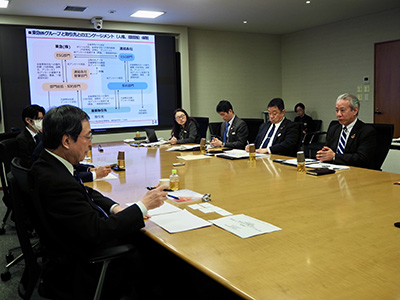
In a dialogue with experts held in March 2025, we welcomed Mr. Masao Seki, Senior Advisor in the Culture Transformation Promotion Department of Sompo Japan Insurance Inc., who also serves as the Chairman of the Corporate Behavior Charter Task Force of the Corporate Behavior and SDGs Committee of the Japan Business Federation, and he exchanged opinions with our Senior Managing Executive Officer Hamana and Managing Executive Officer Kashiwazaki.
*Affiliations and titles are as of the time the expert dialogue was held.
<Main comments
Our Human Rights Policy stipulates, "6. Education and training: the Company and its consolidated subsidiaries will provide appropriate education and training to officers and employees, and will endeavor to instill understanding in our business partners, so that this policy is incorporated into all business activities and implemented effectively." and we are implementing initiatives in accordance with this policy.
Our Human Rights Policy stipulates, "6. Education and training: the Company and its consolidated subsidiaries will provide appropriate education and training to officers and employees, and will endeavor to instill understanding in our business partners, so that this policy is incorporated into all business activities and implemented effectively." and we are implementing initiatives in accordance with this policy.
In fiscal 2025, we created a training video and handbook on "Business and Human Rights" related to sustainability and conducted company-wide training for all employees. All participants passed the post-training test for trainers. Furthermore, the video is available for viewing by consolidated subsidiaries and business partners who do not have access to our e-learning system, so it is viewed not only by our employees but also by consolidated subsidiaries and those in our supply chain. An English version of the video has also been produced, making it possible to view it at overseas business locations.
In formulating Human Rights Policy Human Rights Policy, we held training and workshops for division Manager to promote internal understanding and gather opinions. We received cooperation from the Caux Round Table Japan, a non-profit organization, who gave a lecture to deepen understanding of "business and human rights," including the "Guiding Principles on Business and Human Rights." We also held a workshop where participants considered and discussed Human Rights Policy should have. The content of the discussions held by the participants in this workshop will be used in formulating Human Rights Policy.
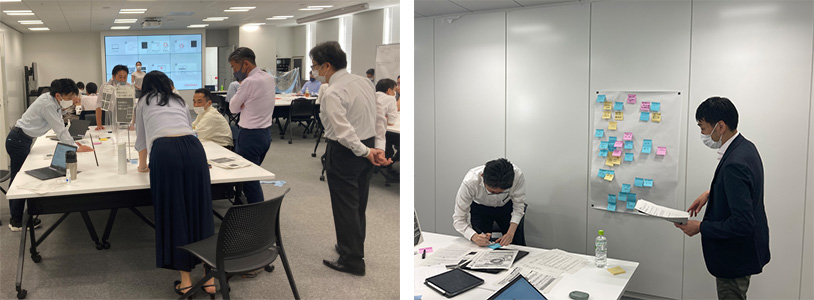
Scenes from the workshop
We provide education and training on human rights to new recruits in an effort to promote understanding.
Career support and human resource development
In July 2022, we held a sustainability seminar to raise awareness of business and human rights for our full-time officers and representative directors of our consolidated subsidiaries, named "Business and Human Rights: What we should do in pursuit of new corporate values."
We invited a lecturer from Caux Round Table Japan, a registered NPO, to lead the seminar, during which participants learned about the essential actions the Group shold take with regards to business and human rights. During the lecture, we received insight on what should remain steadfast and what must be changed based on world trends, such as the UN Guiding Principles on Business and Human Rights as well as our Group philosophy and the Company's DNA.
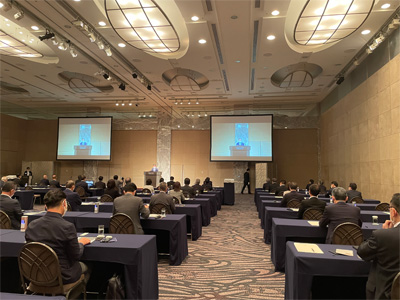
Scenes from the seminar
In "Sustainable Supply Chain Policy", we have set forth "Respect for Human Rights" as the items to be complied with in accordance with our "Human Rights Policy" for the entire supply chain including direct or indirect business partners related to all goods, services and raw materials procured and provided in the business of the Company and its consolidated subsidiaries.
When selecting new suppliers, we ask for their understanding of "Sustainable Supply Chain Policy" and cooperation in putting it into practice, and we select suppliers that conform to this policy. In addition, we regularly check the status of compliance with our procurement policy, which reflects our Human Rights Policy, with suppliers with whom we have ongoing business relationships, and encourage them to make improvements as necessary.
We also created an e-learning course on sustainability, "Business and Human Rights," in FY2025, which is available for our supply chain to view.
In addition to the internal whistle-blowing desk, we have a lawyers’ office for our own employees and those of our subsidiaries (including suppliers) to report to and consult. In addition, the Tokyu Corporation Customer Service Center responds to customer comments and inquiries.
In addition, the Tokyu Corporation Customer Service Center responds to customer comments and inquiries.
Internal whistle-blowing system to address compliance issues
Tokyu and its consolidated subsidiaries have established Human Rights Policy to respect the human rights of all people affected by business activities. We believe that respecting human rights also requires that employees who provide services and products to customers are healthy both physically and mentally, and that we provide a workplace environment where they can work with peace of mind.
Furthermore, in accordance with the "Tokyu Group Compliance Guidelines" and "Code of Conduct," we strive to provide services that are considerate of our customers and other related parties and that meet their trust and expectations, but sometimes some customers make intimidating, psychologically or restrictive remarks and actions, make excessive demands that go beyond the bounds of social common sense, and engage in sexual harassment. To ensure that employees can maintain and improve the services they provide to customers with peace of mind, we have established a "Policy on Customer Harassment" and have positioned it as a common policy.